

 It all began in 1958 with two 45 singles and the EP Hammond Sensations, when the organist, pianist, accordionist, and arranger recorded his first records in stereo.
The son of police inspector Fritz Wunderlich, Klaus was born in Chemnitz in 1931. He was seven years old when he received his first piano lessons, and within just a few years, he had mastered the necessary basics. "I didn't inherit my musicality from my parents - and I never attended a conservatory either," he recalled when asked about the roots of his talent. He found his way to music because, as a child, he was "always a bit weak and therefore a loner."
At the time, the ensemble of the municipal theater, which had been partially destroyed by the bombings of World War II, moved its rehearsals to the gymnastics hall of the school gymnasium. "That's where they discovered me - 'there's someone in year 5 who plays the piano really well' - and that's how, at 16 years of age I became a rehearsal pianist”. However, the jazz, pop, and popular music of the post-war years appealed to him more than classical heavyweights.
Klaus soon discovered jazz and ventured onto politically shaky ground. At the time, jazz was considered "degenerate music" and was banned. "Sometimes I would walk three hours just to take part in these sessions," he recalls. Its not often known but he also played the trombone on the side. Shortly afterward, he received an offer for an engagement in the North Rhine City of Hamm in Westphalia to play in a bar quintet. He accepted and settled in West Germany in 1951.
During his engagement in Hamm, he had already begun making connections to form a bar trio. However, the trio's leader insisted, "Without the accordion, we have no chance!" As a result, Klaus taught himself to play the accordion in 1952, alternating between piano and accordion during performances. Three-part vocal harmonies rounded off the performances of the Fritz Reichel Trio,which primarily played in northern Germany in 1952/53. His musical role model on the accordion was the American Jazz Accorionist Art van Damme. Klaus's signature style as an accordion jazz musician was his ability to sing improvised choruses in unison with his own head voice.
After the Reichel Trio disbanded, Klaus joined the New Jazz Group in Hannover for two months, playing cool jazz. By that time he was an outstanding jazz pianist. Although he first encountered the new Hammond organ in bars and dance halls and was impressed by its sound, he still saw himself primarily as a pianist. That changed when he learned that the pianist at Hanover’s top bar, Chez Nous, had dropped out at short notice. Klaus happened to be in the right place at the right time and Jazz took a back seat. He later said "I now wanted to make music for a wide audience," a principle he remained true to for the rest of his life.
His next engagement was with Willi Mohler. The Mohler Trio - featuring piano, bass, and guitar - played in Mannheim for the opening of the small restaurant Simplicissimus. One major challenge for pianists at the time was the poor condition of most pianos. During a two-month engagement in Ulm in 1955, Mohler, the trio's leader, had the ground breaking idea of replacing the piano with a Hammond organ.
The first performances at Simplicissimus were played without an organ. However, after the first few weeks, a Hammond M3 was rented from a Mr. Seyfferth (nicknamed Balbo) and later purchased. The trio soon realized that the Hammond was a better fit than the accordion and rented their own M3 in the Nuremberg area and thus the Mohler Trio became the first bar trio to feature a Hammond organ. A new sound was born, and the trio was immediately successful. Klaus developed a deep connection with the instrument, later declaring: "The organ is my life!" - a sentiment dating back to these years.
 After the trio disbanded, Klaus settled in Mannheim and by chance, he reconnected with Ernst Seyfferth from Simplicissimus, who was eager to have Klaus as a resident Hammond player in his venue. On the condition that stayed for at least a year, Seyfferth bought a Hammond M3 and Klaus was appointed musical director at the venue which also featured cabaret performances - an ideal setting for his humour and stage presence. He played every night from 8:00 PM to 3:30 AM and even performed as a cabaret artist.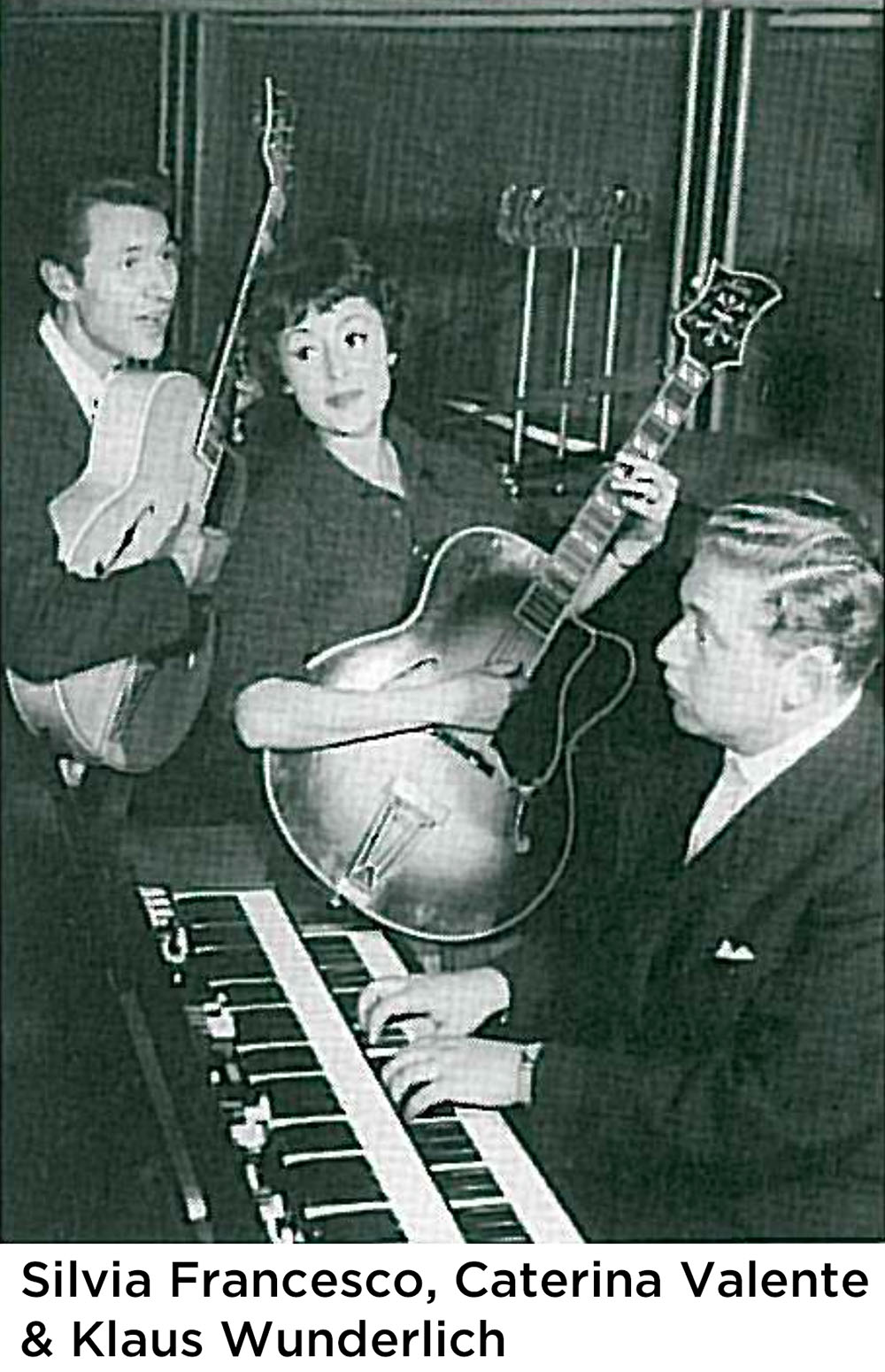
Around this time, the first tape recorders (such as the Grundig TK 8) became available. Having purchased one he recorded his Hammond performances on tape and then accompanied himself on the piano. The resulting sound was a sensation. He soon gained a reputation as an expert on a new instrument - the Hammond organ.
In 1957/58, Simplicissimus. became a popular meeting place for the press and celebrities, including Caterina Valente and Horst Jankowski and eventually, the record industry took notice. In 1958, Teldec commissioned produce to produce his first record, Hammond Sensations, on a Hammond C3. This EP featured four tracks, all arranged by him.
 For the recording, he worked with a three-man rhythm section and pioneered a technique that foreshadowed multi-track recording. He overdubbed his organ multiple times: a mono recording was made, then a new recording was added during playback, and the process was repeated—sometimes up to four times, as in his composition Orgel-Riff. Notably (no joke intended!) his unique way of playing the Hammond and utilizing its vast tonal range was unlike anything heard before. He always played his Hammond organs dry - without a Leslie speaker - because he felt that the percussion sound lost its bell-like clarity and leaned too much toward a jazz tone.
The record, with its ground breaking new sound, was an instant sensation and received heavy radio play. This success was followed by the release of the second EP, Cuban Hammond Delicado, and the first LP, Hammond Specialties for Dancing. The introduction of stereo technology in the late 1950s led to the creation of the first Hammond stereo LP, 24 Melodies You'll Never Forget, which became his his first successful long-playing record.
In 1959 Klaus secured an engagement as an accompanist for Caterina Valente: purchased his first Hammond M3, and spent a year and a half touring with her, which included performances at venues such as the Olympia in Paris. During this time, he recorded several pieces with the Werner Müller Orchestra. Faced with a lack of sheet music, he simply wrote two arrangements himself overnight.
Klaus continually sought ways of mastering the art of blending musicality with the technical intricacies of organ playing. Over his career, he sold more than 20 million records worldwide and earned 13 gold records, along with a Gold Music cassette and in 1981 a special framed plaque awarded to him by the readers of the American KEYBOARD WORLD magazine for his 1981 recording of Inn the Miller Mood. Always striving for perfection, he developed the ability to mimic nearly every common instrument on the Hammond organ. He once remarked, "You can imitate all string instruments on the Hammond organ, except for the butter knife."
His breakthrough came swiftly. His immense success propelled him into the elite ranks of international show business, yet as ever throughout his life he remained humble. He continued touring for years, accompanying stars such as Caterina Valente, Herbert Hisel, Josef Meinrad, Heinz Schenk, and many others on guest appearances and tours. From 1959 to 1972, he travelled several hundred thousand kilometres annually, moving from one engagement to the next.
Radio stations soon began to seek out these musical and acoustic treasures he'd recorded on tape, and soon his name became a household name, earning him the title "Mr. Hammond." He never confined himself to a single genre - his repertoire included everything from the latest hits to classical motifs, operetta, musicals, and pop songs. Regardless of the style, his signature Wunderlich sound was always recognizable - swinging and drifting - and met with widespread acclaim.
Somewhat strangely a newspaper voted him the country's best jazz accordionist! .

TThe record company Teklefunken / Teldec capitalized on this recognition in 1972 by arranging joint recordings between Wunderlich and Hubert Deuringer, who had been the most sought-after accordionist up to that point. The goal was likely to merge Deuringer’s market appeal with Wunderlich’s - a strategy that proved successful.
Later in 1972, Wunderlich chose to leave behind his fast-paced lifestyle. He built his own recording studio in the basement of his home, becoming both musician and recording director. Never one to resist the rapid advancements in electronic sound production, he remained a perfectionist and innovator, and in the early 1970s, he recognized that “the sound of the Hammond organ was slowly being exhausted. Something new was needed..."
Thus, he pioneered the legendary New Pop Organ Sound by ingeniously blending the tones of three different types of organs. Using the multi-playback method, he was able to achieve orchestral-quality recordings - so precise that even a real orchestra would envy them. From that point on, he recorded all the instrumental parts himself, including the drums.
Additionally he also experimented with the MOOG synthesizer and used technical ingenuity to create entirely new sounds - even from the good old piano. "I play on anything that can be touched," he once said. This spirit of innovation led to productions such as the Wunderlich Pops series, Sound 2000, and the uniquely titled Uraltedelschnulzensynthesizergags, all of which achieved international success.
His distinctive approach to playing and sound design produced music that had never been heard before - and would never be forgotten. However, this complex, layered sound could only be replicated in the studio; it was impossible to recreate on the concert stage.
 Those in the know were already astonished that Klaus Wunderlich could produce such flawless recordings entirely on his own in his home studio, without any external assistance. In 1977, when the Wersi company introduced a revolutionary new generation of organs with the Helios model, his career took a new turn - returning to live and television performances.
The Helios organ, when under the command of someone with his technical and musical knowledge, could sound like a full orchestra even in live settings. As a result, his concerts were once again sold out, and he became a major star, particularly in England. In April 1978, he achieved the remarkable feat of performing in a sold-out Royal Albert Hall concert for the second time in a year - an accomplishment many musicians could only dream of. Since the Wersi Helios was also available as a kit, he assembled his own instrument, further deepening his technical understanding of electronics.
 By the late 1970s, Klaus had begun practicing transcendental meditation, with esotericism gradually playing a more significant role in his life. "My goal in life is to improve my character and become a better person. This, in turn, is transferred to the audience," he once said. "After the release of the album In the Miller Mood - the first record I made after I began meditating - many people told me there was something in the music that they loved, though they couldn’t explain why. That’s exactly what I mean when I say that music carries the personality of the musician into the subconscious of the listener. A machine has no feelings..."
Over time, even the Helios organ no longer met the technical demands of the era, and true to his motto "Never rest on your laurels, always move with the times - both
musically and technically," he first added the Beta digital organ to his Helios, before ultimately replacing both with the Wersi Spectra. He mastered each instrument, pushing their capabilities to the limit. Even in an age where computers increasingly dominated the music and media landscape, Klaus remained committed to real, hands-on musicianship. "When I record, I actually play all the instruments - organ, drums, my small MOOG synthesizer for bass, and the Pianostar for rhythm guitar - by hand," he explained. "I work with eight track format in my studio and everything is recorded individually, then audio corrected if necessary, and later mixed onto a standard studio tape in two-track stereo format at the high speed of 15inchs per second. ."

Despite being a self-professed computer enthusiast—owning four computers, programming them himself, and being highly knowledgeable in the field - he refused to use them for making music. When asked why he continued recording by hand despite the possibilities of digital technology, his response was clear: "Music that comes from a computer has no soul and therefore has no positive effect on the listener! But computers are very useful 'slaves' - they help me print sheet music or program rhythms for the organ, which I need for live performances since I can’t play the organ and drums on stage at the same time."
For Klaus it was evident that music could convey emotions and influence the human subconscious. It had the power to make listeners feel happy, sad, relaxed, energized, or even aggressive. With this belief in mind, he released his 1982 EMI-Electrola album Rendezvous - a collection of well-known evergreens, which he described as "anti-stress music.
Although these sounds can ‘get under the skin’ of sensitive listeners, the music remains unobtrusive and discreet. It calms the nerves, harmonizes the subconscious, and puts the listener in a peaceful mood - whether it is actively listened to or simply playing in the background."
In his later years, Klaus was not ready to rest on his laurels just yet. Only a few weeks after announcing the end of his active career, he was back in his recording studio, working on a new production, which he personally titled Special. "Many of my fans wrote to me, called me, and repeatedly told me that I shouldn't stop. Well, that decision is ultimately mine - but I quickly realized that a musician can never truly 'retire.' If you love what you do, you can't just stop overnight."
 With the release of the CD Special, he aimed to create yet another musical highlight, and so after completing the recordings, he personally designed the cover, oversaw the production of CDs and music cassettes, and even handled distribution himself.
For a long time, the CD was only available exclusively through him. This was the last album Klaus Wunderlich recorded using multi-track technology. "For the first time, I was able to record only the tracks I truly wanted to play - cheerful, swinging pieces that I had long dreamed of interpreting. If sales of the CD prove successful, I will certainly continue this way."
Eventually the first edition of Special sold out, and a new edition with an updated cover became available. Thanks to this Special CD, Klaus rediscovered his joy in music. His boundless creative energy led him to make new plans. "I still have ideas for 20 more productions," he said in September 1997. He also proposed improvements and expansions for his official website, something he had not been very happy about in later years, though unfortunately, these could only be partially implemented in the existing version.
Then, suddenly and completely unexpectedly, Klaus suffered a fatal heart attack on October 28, 1997, in the presence of his wife, Traudl, and Swiss friends. He was only 66 years old. In the weeks and months leading up to his tragic passing, there had been no signs of any health issues, making the news all the more shocking for those who knew him.
Despite his immense success and popularity, his death was almost entirely ignored by the media. In a letter of condolence to Wunderlich's widow, his longtime companion Heinz Schenk expressed his disbelief: "I cannot understand the behavior of the media, which did not mention his death with a single line or sentence. I made my feelings on this matter very clear in the appropriate circles..."
Despite his immense success and popularity, his death was almost entirely ignored by the media. In a letter of condolence to Wunderlich's widow, his long-time companion Heinz Schenk expressed his disbelief: "I cannot understand the behaviour of the media, which did not mention his death with a single line or sentence. I made my feelings on this matter very clear in the appropriate circles..."
The memory of Klaus Wunderlich and his music may bring a sense of melancholy, but he will always be remembered as a great artist, a cherished colleague, and an inspiration. He lives on in the hearts of countless musicians and fans.
Shortly before his passing, Klaus had begun working on a new CD. He had long planned to release an album featuring recordings of his live concerts. "I still need to 'polish' it a bit. I have almost all the recordings here on tape, but they need to be reworked for a CD release. I think I'll re-record them live in my studio..." This idea led to Concerto Grosso in 1996, a production based on classical themes, arranged in a way that was nearly impossible to perform due to its technical difficulty. He wanted to showcase his extraordinary talent and unique playing technique one last time.
In a conversation in September 1997, he casually remarked, "Lately, I've been playing the organ more often again. But I've just decided to tackle a piece that's nearly unplayable on the organ - I'll probably need to practice a bit more..." As it later became clear, he was referring to Donna Diana,
the final piece on the CD release Concerto Grosso. For this album, Klaus abandoned the multi-playback technique he had often used in his recordings, opting instead for a more organic and authentic performance. In this sense, Concerto Grosso stands as his final live concert - a remarkable legacy for his fans.

This biography is based on an article from the former magazine okey.de by Ralf Hoffmann, supplemented with additional information from various sources.